A Record-Breaking Year: Exploring the UK’s Climate in 2025
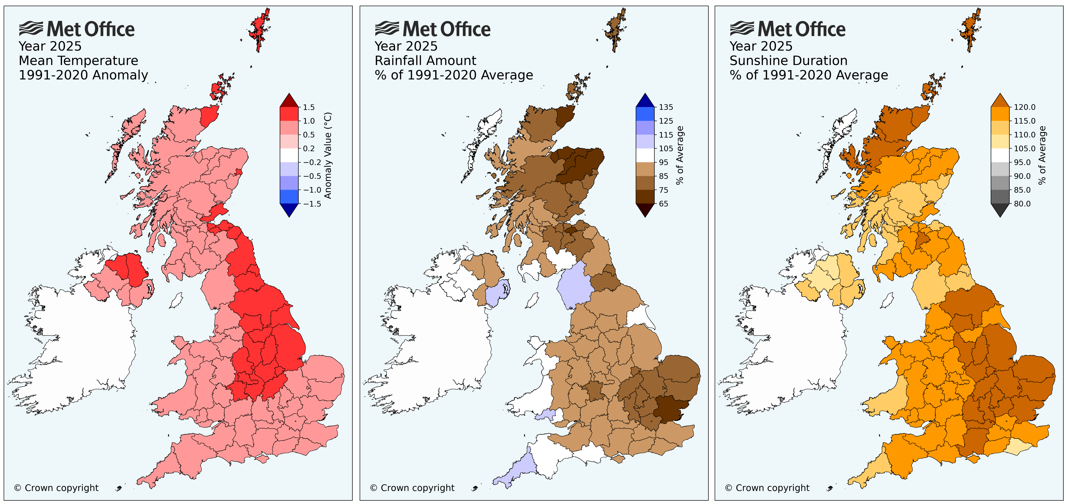
The year 2025 has etched itself into the annals of the UK’s climate history, marking a significant turning point as the warmest and sunniest year ever recorded since systematic observations began. This remarkable year joins an already alarming trend that includes 2024, 2023, 2022, and 2014, all of which rank among the top five warmest years in UK history. The implications of these soaring temperatures speak volumes about the ongoing impact of human-induced climate change, revealing not just a statistical anomaly but a troubling pattern that could redefine weather norms for future generations.
Data compiled by the Met Office provides a comprehensive overview of the climatic conditions experienced throughout 2025. Notably, January and September were the only months that deviated from this warming trend, exhibiting cooler-than-average temperatures. An attribution study conducted by the Met Office emphasized the stark contrast between today's climate and the pre-industrial era, revealing that the average temperature recorded in 2025 would have been virtually impossible to achieve without the influence of human activities. In fact, the study estimates that such extreme temperatures could now occur approximately every three years, a striking shift that underscores the urgency of addressing climate change.
Spring 2025 emerged as the warmest on record, surpassing the preceding record set just the year before. This spring was not only characterized by elevated temperatures but was also the sunniest ever documented, ranking as the fourth sunniest season in history, following the storied summers of 1976, 1996, and 1911. In parallel, the summer of 2025 shattered previous temperature records, with the likelihood of such an event being intensified by climate change, now estimated to occur nearly 70 times more frequently due to anthropogenic influences. The high-pressure systems that dominated the spring and summer months not only contributed to the warmth and sunshine but also led to a significant dry spell, making it the driest spring since 1974 before wetter conditions returned late in the year.
An analysis of rainfall data indicates that the UK concluded the year with approximately 90% of its average annual rainfall. However, this figure masks regional disparities, with areas like Essex, Moray, and Aberdeenshire experiencing less than 75% of their normal annual precipitation. In stark contrast, western counties such as Cornwall and Cumbria recorded slightly above-average rainfall at 110% and 107%, respectively. As climate scientists underscore, these variations highlight how climate change can manifest differently across geographical regions, leading to localized extremes that can have profound impacts on agriculture, water supply, and ecosystems.
The year also witnessed the emergence of several notable storms, underscoring the volatility of the climate system. Storm Éowyn, which struck in late January, was recognized as the most powerful windstorm in over a decade and marked the most severe storm to impact Northern Ireland since 1998. Similarly, Storm Floris, which hit in early August, brought significant winds to Scotland, while Storm Amy unleashed heavy rainfall across north-western parts of the UK in early October, resulting in the wettest day of the year. These storm events serve as stark reminders of how climate change can intensify weather patterns, leading to more frequent and severe weather events that pose risks to life, infrastructure, and economic stability.
The significance of these findings cannot be overstated. The Met Office's HadUK-Grid dataset, which has been the backbone of historical weather analysis since 1884, places the recent climatic conditions into a broader context. The data illustrates how the entire UK experienced above-average temperatures in 2025, with central and north-east England, along with parts of Northern Ireland and the northern tip of Scotland, experiencing the most pronounced changes. With such data in hand, scientists can better understand the trajectory of climate change and the human contributions that have exacerbated its effects. The clear upward trend in temperatures and the increasing frequency of extreme weather events present a compelling case for urgent action to mitigate the impacts of climate change and adapt to its inevitable consequences.
As we reflect on the climatic anomalies of 2025, it is crucial to recognize that these trends are not isolated incidents. Rather, they represent a convergence of factors driven by human activities, from greenhouse gas emissions to land use changes. The UK’s average temperature for 2025 was recorded at 10.09°C, marking only the second time that the annual average temperature has exceeded 10°C, following a similar occurrence in 2022. This alarming trend underscores the importance of continued research and public awareness surrounding climate change, emphasizing that while record-breaking years may become more common, proactive measures can still be taken to curb the trajectory of our warming planet. Ultimately, the climate of 2025 serves as both a warning and a rallying call for collective action to foster a sustainable future.