Africa Is Splitting Apart Faster Than Expected, and It May Explain Why We Find So Many Fossils There
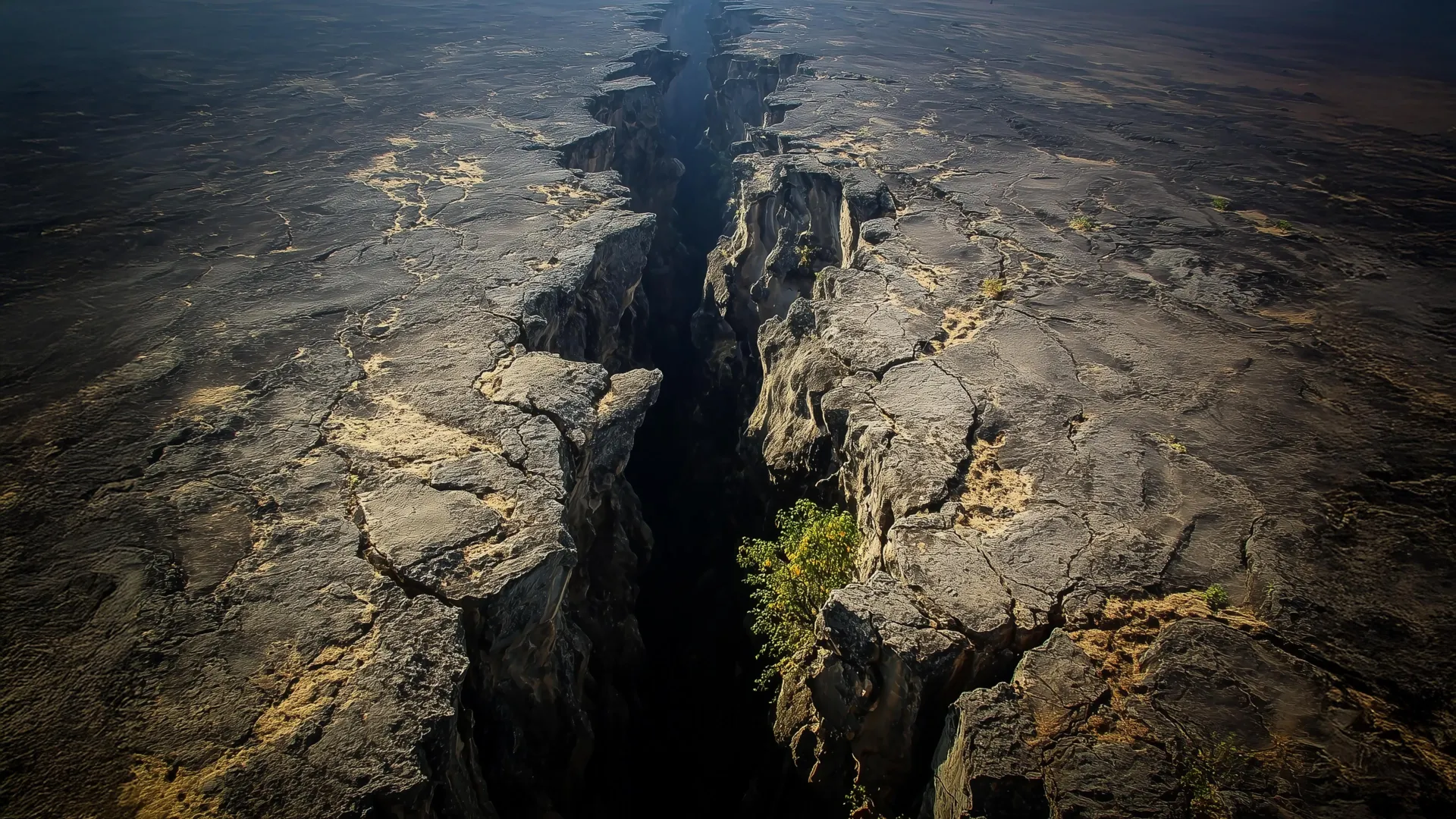
Deep beneath the sun-baked landscapes of East Africa's Turkana region, the continental crust is stretching and thinning to a critical threshold that scientists say represents a more advanced stage of continental breakup than previously recognized. New geophysical research has revealed that the lithosphere beneath the Turkana Rift has reached a phase called "necking," where the crust narrows dramatically at depth much like a piece of taffy being pulled apart. This finding suggests that the geological processes that will eventually split Africa into two separate landmasses and create a new ocean basin are further along than most models had predicted.
Continental rifting is one of the most fundamental geological processes shaping Earth's surface, responsible for creating ocean basins, mountain ranges, and the arrangement of continents we see today. The East African Rift System stretches thousands of kilometers from the Afar Triangle in the north through Kenya, Tanzania, and into Mozambique, representing the most active continental rift on the planet. Scientists have long studied this system as a natural laboratory for understanding how continents break apart, but the Turkana segment in northern Kenya has received comparatively less attention despite occupying a critical position where the eastern and western branches of the rift interact.
The research team used advanced seismic imaging techniques to construct three-dimensional models of the crustal structure beneath the Turkana region. What they found was striking: the crust has thinned to approximately 20 kilometers in some areas, compared to the 35-40 kilometer thickness typical of stable continental interiors. More significantly, the pattern of thinning shows the characteristic geometry of lithospheric necking, where deformation concentrates in a narrow zone rather than being distributed broadly. This necking phase represents a point of no return in the rifting process, after which the crust will continue thinning until it ruptures completely, allowing magma from the underlying mantle to create new oceanic crust.
Perhaps the most fascinating aspect of this research is its connection to human paleontology. The Turkana Basin is one of the world's richest repositories of hominin fossils, containing remains spanning millions of years of human evolutionary history. Researchers have long debated whether this reflects the region's importance as a cradle of human evolution or simply its exceptional preservation conditions. The new geological findings strongly support the latter interpretation. The same tectonic forces that are pulling the continent apart also created the sedimentary basins, volcanic ash layers, and rapid burial conditions that are ideal for fossil preservation. Bones deposited near an active rift are quickly covered by sediments from eroding fault scarps and volcanic eruptions, protecting them from weathering and destruction.
This reinterpretation carries profound implications for how we understand the geographic origins of our species. Rather than assuming that regions with abundant fossils were necessarily centers of evolutionary innovation, scientists must consider that fossil distribution maps primarily reflect preservation bias. Early humans likely occupied a much broader geographic range across Africa than the fossil record suggests, but their remains were only preserved in the specific geological settings created by tectonic activity. Areas with stable, eroding landscapes simply destroyed the evidence of human occupation over millions of years, while rifting zones acted as natural archives that captured and stored biological history.
Looking far into the future, the geological forces documented in this study will continue their slow but relentless work. Current estimates suggest that the Turkana Rift and the broader East African Rift System will eventually split the continent completely, creating a new ocean that separates the Somali plate from the rest of Africa. This process will take tens of millions of years to complete, but the necking phase identified in this research indicates that the point of irreversibility may already be approaching. The same forces that preserved our ancestors' bones are actively reshaping the continent, demonstrating how geological processes operating on vastly different timescales can intersect in ways that illuminate both Earth's deep past and its distant future.