Early 2026 on Track for Second-Warmest Year as Strong El Nino Brews
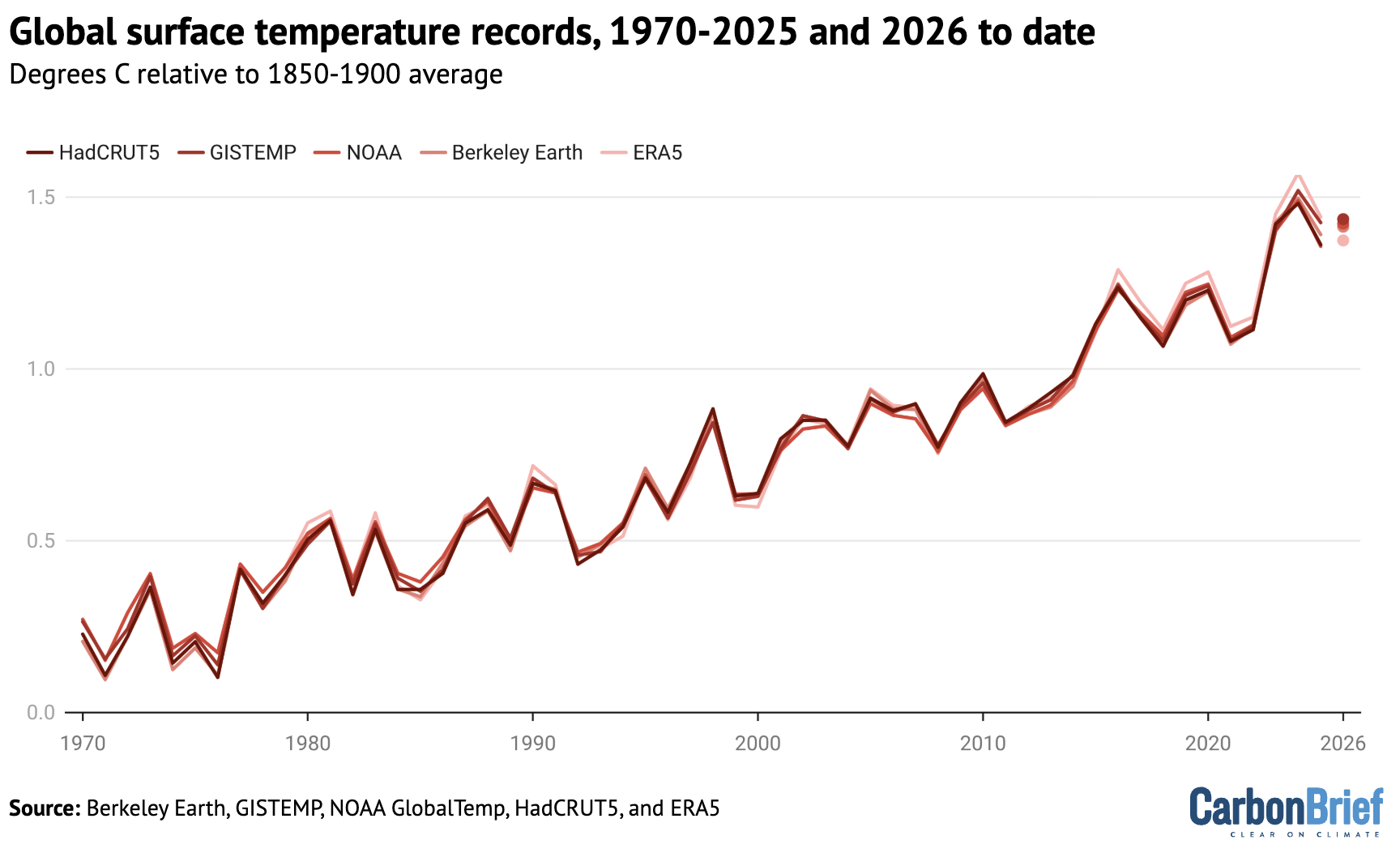
The first three months of 2026 rank among the four warmest such periods ever recorded, and scientists now expect a strong El Nino to develop by autumn, placing the year firmly on track to become the second warmest on record. The assessment, based on data from five leading global temperature records, signals that despite a brief cooling influence from weak La Nina conditions earlier in the year, the planet's long-term warming trend is continuing with little sign of slowing.
Carbon Brief's quarterly analysis draws on temperature datasets from NASA, NOAA, the Met Office Hadley Centre and the University of East Anglia, Berkeley Earth, and the European Copernicus service. All five agencies placed January 2026 among the five warmest Januarys on record, February between the fourth and sixth warmest, and March between the second and fourth warmest. Combined, the quarter came in just behind 2024, 2025, and 2016, the three warmest starts to a year in the instrumental era.
That ranking is notable because La Nina, which typically suppresses global temperatures by several hundredths of a degree, was still weakly active in January and February. The fact that temperatures remained so elevated despite this natural cooling influence underscores the strength of the underlying human-driven warming signal. As La Nina has faded through the spring, monthly anomalies have climbed steadily, a pattern consistent with the transition to a warmer phase of the El Nino Southern Oscillation.
Looking ahead, thirteen major modeling groups have published forecasts of El Nino strength extending through at least September, with more than six hundred individual model runs between them. The central expectation is for a strong El Nino, and several runs produce a super El Nino on par with the record 1997 and 2015 events. Strong El Ninos typically raise global average temperatures by around one to two tenths of a degree and bring distinctive regional effects, from drought in Indonesia and northern South America to heavy rainfall on the western coasts of the Americas.
Carbon Brief's statistical projection, built from the five temperature records and the current forecast distribution, assigns a roughly nineteen percent chance that 2026 will overtake 2024 as the warmest year on record. Because a full El Nino takes time to influence annual averages, the larger effect is likely to appear in 2027, which forecasters now consider the most probable candidate for a new warmth record. Either way, 2026 is virtually certain to rank among the four warmest years ever observed.
The Arctic has added to the early 2026 story. Sea ice extent during the winter maximum tied with 2025 for the lowest ever recorded in the satellite era, reflecting the continued impact of warming air and ocean temperatures at high latitudes. Low winter maxima tend to set the stage for vulnerable summer melt seasons, because thinner ice entering spring melts more quickly once the sun returns. Scientists will be watching closely whether a strong El Nino in the Pacific further amplifies Arctic warming through atmospheric teleconnections.
Regional contrasts in the first quarter were stark. Parts of Europe, the United States, and central Asia saw unusually mild winter conditions, while scattered cold snaps were balanced by record warmth in the Southern Hemisphere. Ocean heat content reached new highs in several basins, continuing a trend that is linked to coral bleaching events, shifts in fish populations, and the intensification of tropical storms.
Policymakers face familiar dilemmas. Greenhouse gas emissions continue near record levels even as clean energy deployment accelerates, meaning that the atmospheric stock of carbon dioxide and methane is still growing. Achieving the Paris Agreement's goal of limiting warming to well below two degrees Celsius, let alone one and a half degrees, will require a faster turnover of the global energy system than current projections envisage. Every year that exceeds the historical norm makes the remaining carbon budget smaller.
For the general public, the practical consequences are already visible. Heat waves are starting earlier and lasting longer, growing seasons are shifting, and the atmosphere holds more water vapor, which in turn fuels heavier downpours and flash flooding. The Carbon Brief analysis is less a warning about the future than a status update on a climate that has already changed, with another likely top-tier year now underway.
Scientific attention is also turning to the compounded effects that a strong El Nino could produce on top of already elevated baseline temperatures. Research published over the past several years has demonstrated that El Nino years amplify the probability of extreme heat events across many parts of the world, often by factors of two or three compared to neutral years. With global average temperatures now running roughly one and a half degrees above the pre-industrial baseline, analysts warn that even a moderate El Nino could push many regions into unprecedented conditions during the second half of 2026 and the first half of 2027. Health authorities are preparing contingency plans for heat-related illness surges, particularly in urban centers where nighttime cooling has become increasingly rare. Water utilities in drought-prone regions are revising reservoir management rules, because a strong El Nino can bring either pronounced wet or dry extremes depending on geography. Agricultural ministries are modeling potential disruptions to staple crops such as rice, maize, and wheat, and export-dependent economies are bracing for volatile commodity prices. The insurance industry is similarly adjusting. Reinsurers have begun incorporating a higher probability of concurrent climate hazards into their 2026 risk models, reflecting the expectation that El Nino will raise the odds of multiple severe events occurring simultaneously in different parts of the world. Catastrophe bond pricing has responded accordingly, with premiums for tropical cyclone and flood covers edging higher in several markets. Taken together, the first quarter data and the forecasts that follow reinforce a now familiar pattern. Each new year arrives with routine expectations of disruption, and each new season underscores that the climate system is not simply warming, but doing so in ways that stretch the planning horizons of every institution charged with keeping the world running.