G7 Economies Lag Behind China in Renewable Energy Development Amid Record Growth in Wind and Solar Power
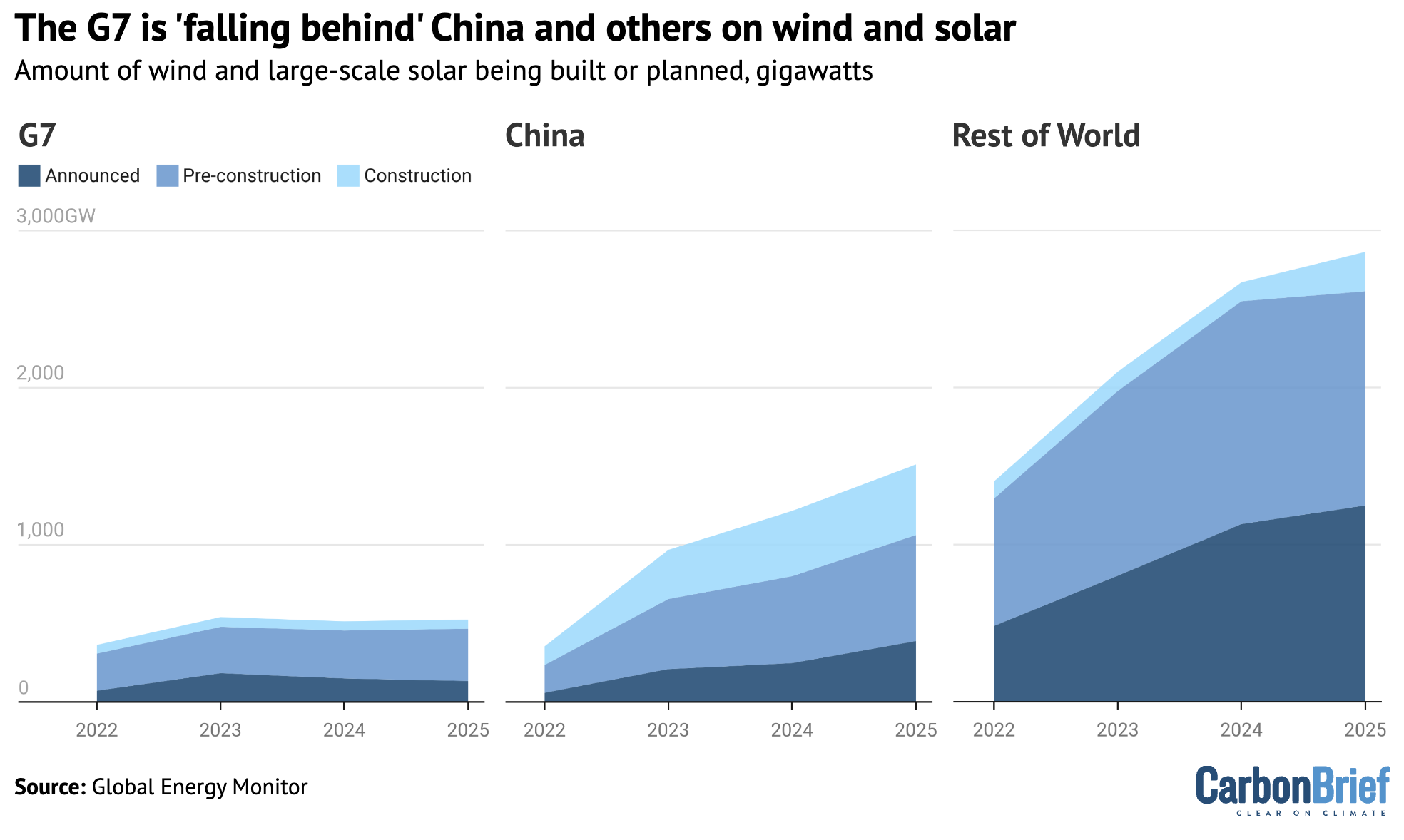
Recent findings from Global Energy Monitor (GEM) reveal a striking gap in renewable energy development between the G7 nations and other parts of the world, particularly China. By 2025, the global capacity for wind and large-scale solar energy is set to reach an astonishing 4,900 gigawatts (GW), showcasing an increase of 500 GW, or 11%, from the previous year. This surge in renewable energy projects is predominantly led by developing economies, highlighting a significant shift in the global energy landscape. China is at the forefront of this movement, boasting a pipeline exceeding 1,500 GW, which dwarfs the combined efforts of the next six countries, Brazil, Australia, India, the United States, Spain, and the Philippines, which collectively hold just over 1,000 GW of planned capacity. In stark contrast, the G7 nations, comprising the United States, United Kingdom, France, Germany, Italy, Canada, and Japan, represent only 520 GW, a mere 11% of the total global pipeline, despite controlling roughly half of the world's wealth. This disparity raises critical questions about the future leadership of G7 countries in the booming renewable energy sector.
The implications of this data are profound, as they signify a pivotal moment in global energy policy and economic strategy. Diren Kocakuşak, a research analyst at GEM, has indicated that the G7 countries might be ceding their leadership roles in an area that is rapidly evolving into a cornerstone of sustainable development. With the center of gravity for new clean power projects shifting decisively toward emerging and developing economies, the G7 nations risk falling behind in a sector that is not only vital for combating climate change but also increasingly important for economic growth and job creation. This stagnation in the G7's renewable energy development is particularly notable given the wealth and resources available to these nations, and it raises concerns about their commitment to international climate goals.
A closer examination of the global wind and solar pipeline reveals that of the total 4,900 GW, 2,700 GW is attributed to wind energy, while 2,200 GW pertains to large-scale solar projects. However, the rate of expansion for these projects has notably slowed in recent years, dropping from a growth rate of 22% in 2024 to just 11% in 2025. This slowdown is especially pronounced in the wind energy sector, which has faced significant challenges, including political barriers and unsuccessful auction processes. For instance, offshore wind subsidy auctions in Germany and the Netherlands failed to attract any bids in 2025, while Denmark cancelled its own auction due to a lack of bidders. These setbacks underscore the complexities and uncertainties that can hinder the progress of renewable energy initiatives, even in nations with established infrastructure and investment capabilities.
The urgency for advancement in renewable energy capacity is further underscored by global commitments made at the COP28 conference in 2023, where countries pledged to triple their renewable energy capacity by 2030. This ambitious target, which is generally based on a 2022 baseline, necessitates an average annual addition of 317 GW of wind and 735 GW of solar capacity worldwide. In 2025, approximately 758 GW of wind and solar projects are under construction, with a significant portion, around three-quarters, located in China and India. These developments signify a declining reliance on coal for electricity generation in both nations, aligning with broader efforts to transition to cleaner energy sources. As the world enters the final five years of the implementation period for these commitments, the ability to meet these targets will hinge on the growth of the renewable energy pipeline.
GEM's analysis primarily draws on data from its Global Solar Power Tracker and Global Wind Power Tracker, which focus on projects with capacities of at least 1 megawatt (MW) for solar and 10 MW for wind. This comprehensive data collection highlights the increasing importance of large-scale renewable energy projects in addressing climate change and achieving energy security. As countries grapple with the challenges of energy transition, the emphasis on scaling up renewable energy infrastructure becomes critical. The stark contrast between the G7’s stagnation and the rapid expansion in other parts of the world exemplifies the need for a renewed focus on policy frameworks that encourage investment and innovation in renewable technologies.
In conclusion, as the world grapples with the pressing need to address climate change and move toward sustainable energy systems, the disparity in renewable energy capacity between the G7 and developing nations raises critical questions about leadership and responsibility. The G7 countries must reevaluate their strategies and commitments to avoid falling further behind in the global race for clean energy. The growth of wind and solar power not only represents an opportunity for environmental sustainability but also for economic growth and technological advancement. As the future unfolds, the ability of nations to adapt and innovate in the face of these challenges will determine their role in shaping a sustainable and resilient energy landscape.