Global Climate Week in Review: Fossil Fuel Power Slides, Super El Nino Looms, and Afghanistan's Rising Peril
Events across energy markets, scientific research, and international diplomacy converged this past week to underscore just how tightly climate change is now woven into the fabric of global affairs. Oil prices rebounded past 100 dollars per barrel on Monday after peace talks between the United States and Iran broke down and the US president ordered a blockade of Iranian ports. The jump reversed a decline from the prior week that had followed news of a conditional ceasefire, and it sent European governments scrambling to protect households and businesses from a fresh surge in energy costs. Ireland unveiled a support package worth roughly 505 million euros, Germany agreed on measures valued at 1.6 billion euros, and a draft proposal circulating within the European Union would speed up the rollout of clean power while pushing electricity prices downward.
Political pressure on climate policy also intensified. The US president renewed his long-running critique of the United Kingdom's energy strategy, urging the British government to expand North Sea oil production with his trademark phrase about drilling. Across the Atlantic, countries attending spring meetings of the International Monetary Fund and the World Bank were reportedly pressured not to mention climate change at all, according to reporting from the Guardian. Plans to adopt a new climate action plan at the World Bank may now be shelved, along with any substantive discussion of the climate crisis. These developments come at a moment when many developing economies are looking to multilateral lenders for help financing clean energy transitions and adaptation to worsening climate impacts.
A political shift of major consequence arrived in Hungary, where Peter Magyar's centre-right Tisza party delivered a landslide defeat to Viktor Orban's Fidesz government after sixteen years in power. Analysts say the change creates new openings for European climate action, since Hungary has repeatedly vetoed ambitious EU climate measures and blocked efforts to phase out Russian fossil fuel imports. Magyar's manifesto promises to double the share of renewable energy in domestic supply by 2040, lift restrictions on wind turbine construction, and pursue billions of euros in previously frozen EU funds to modernize the country's energy infrastructure. While climate was not a central campaign issue, the change in leadership is widely expected to reduce friction inside the bloc and make it easier for EU negotiators to pursue ambitious targets.
Meteorologists delivered another striking warning this week about the possible development of a so-called super El Nino event, a pattern that could dramatically raise global average temperatures and drive a cascade of extreme weather through the coming summer and beyond. El Nino phenomena arise when warm water pools in the central and eastern equatorial Pacific, shifting atmospheric circulation and rainfall patterns across vast regions. A super El Nino would represent the strongest tier of these events and typically brings drought to parts of Southeast Asia, Australia, and southern Africa, while triggering flooding in South America and intensified heat across many mid-latitude regions. Scientists warn that the combination of a strong El Nino with the existing greenhouse-driven warming trend could push 2026 or 2027 into record-shattering territory.
Turning to climate science, researchers published important new findings across several fronts. A review of editorials in four right-leaning UK newspapers over a four-month window in 2023 found that more than seventy percent contained at least one misleading statement about net-zero policies. A separate study in npj Climate and Atmospheric Science calculated that air pollution from global transportation currently has a net cooling effect large enough to offset roughly 80 percent of the warming impact from the sector's carbon dioxide emissions, meaning that as the world cleans up transport pollution, underlying warming will become more visible. Another analysis published in Science Advances, which incorporates observational constraints on climate model projections, suggests the Atlantic Meridional Overturning Circulation could weaken by as much as 50 percent by 2100 under a medium emissions scenario, a shift that would have far-reaching consequences for weather patterns across Europe, West Africa, and the Americas.
This week's spotlight turns to Afghanistan, where deadly floods, flash floods, and landslides recently struck large parts of the country, destroying thousands of homes, crops, bridges, and roads while claiming nearly 100 lives. Authorities report that about 74,000 people across 31 of 34 provinces were affected. Communities across Afghanistan have been battered repeatedly by flash floods, droughts, and landslides in recent years, creating a compounding humanitarian emergency for a nation already grappling with political isolation and economic collapse. Experts warn that climate impacts are accelerating in the region, adding pressure to livelihoods that were already precarious. The story underscores a recurring theme of modern climate policy, namely that the countries least responsible for greenhouse emissions are often the ones bearing the heaviest and earliest costs of a warming world.
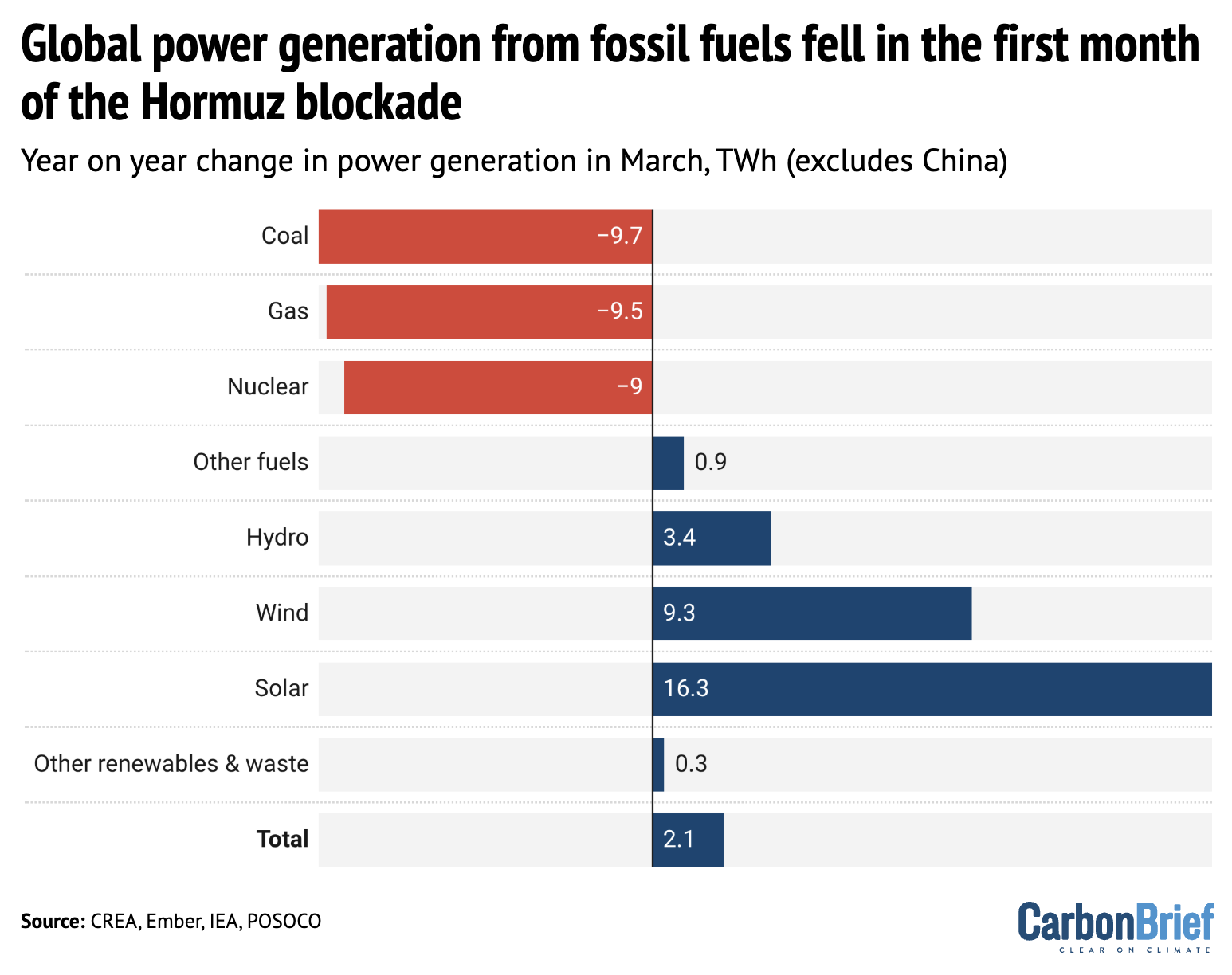
Looking ahead to the next few weeks, several developments are worth watching. The Turkish government unveiled the dates and venues for the leaders' summit segment of November's COP31 conference in Antalya, according to Climate Home News, and the small Pacific nation of Tuvalu will host a special meeting of world leaders before the summit to ensure vulnerable island states remain at the center of discussions. French prime minister Sebastien Lecornu also pledged roughly ten billion euros per year in state support for electrification through 2030, doubling existing commitments as part of a broader push to reduce fossil fuel dependence. Analysis from the Centre for Research on Energy and Clean Air found that global electricity generation from fossil fuels fell during the first month of the Strait of Hormuz disruption, with coal-fired power dropping by 3.5 percent and gas-fired by 4 percent across countries outside China, offset largely by rapid gains in solar and wind output. These shifts, along with evolving political dynamics in Europe and Asia, are likely to shape the climate narrative for months to come.