Hungary's Political Earthquake: What Magyar's Victory Over Orban Means for Europe's Climate Agenda
Hungarian politics has experienced a seismic shift with the landslide defeat of Viktor Orban's Fidesz party by Peter Magyar and his centre-right Tisza party, bringing to an end sixteen years of rule that many observers across the continent had described as a slide toward authoritarianism. The change of government is being welcomed far beyond Hungary's borders, not only by democracy advocates but also by climate policy analysts who have watched Hungary repeatedly stall European Union climate ambition through vetoes and delays. Although Magyar did not make environmental issues the centerpiece of his campaign, his party's manifesto includes an array of significant climate and energy commitments, and his stated willingness to cooperate closely with Brussels opens doors that had been largely shut under Orban.
Over his years in office, Orban developed a complex and sometimes contradictory stance on climate action. He repeatedly described the EU's climate targets as a utopian fantasy that would destroy the middle class, and he accused western elites of wanting people to live in fear of climate change. At the same time, his government pursued a 2050 net-zero goal, committed to phasing out coal power by 2029, and supported the rapid expansion of solar generation. That duality reflected broad public support among Hungarians for acting on climate change while also allowing Orban to appeal to his political base with sovereignty-focused rhetoric against the EU. At EU summits, Hungary under Orban became famous for wielding a blocking veto, slowing the phaseout of Russian fossil fuel imports and diluting collective climate commitments.
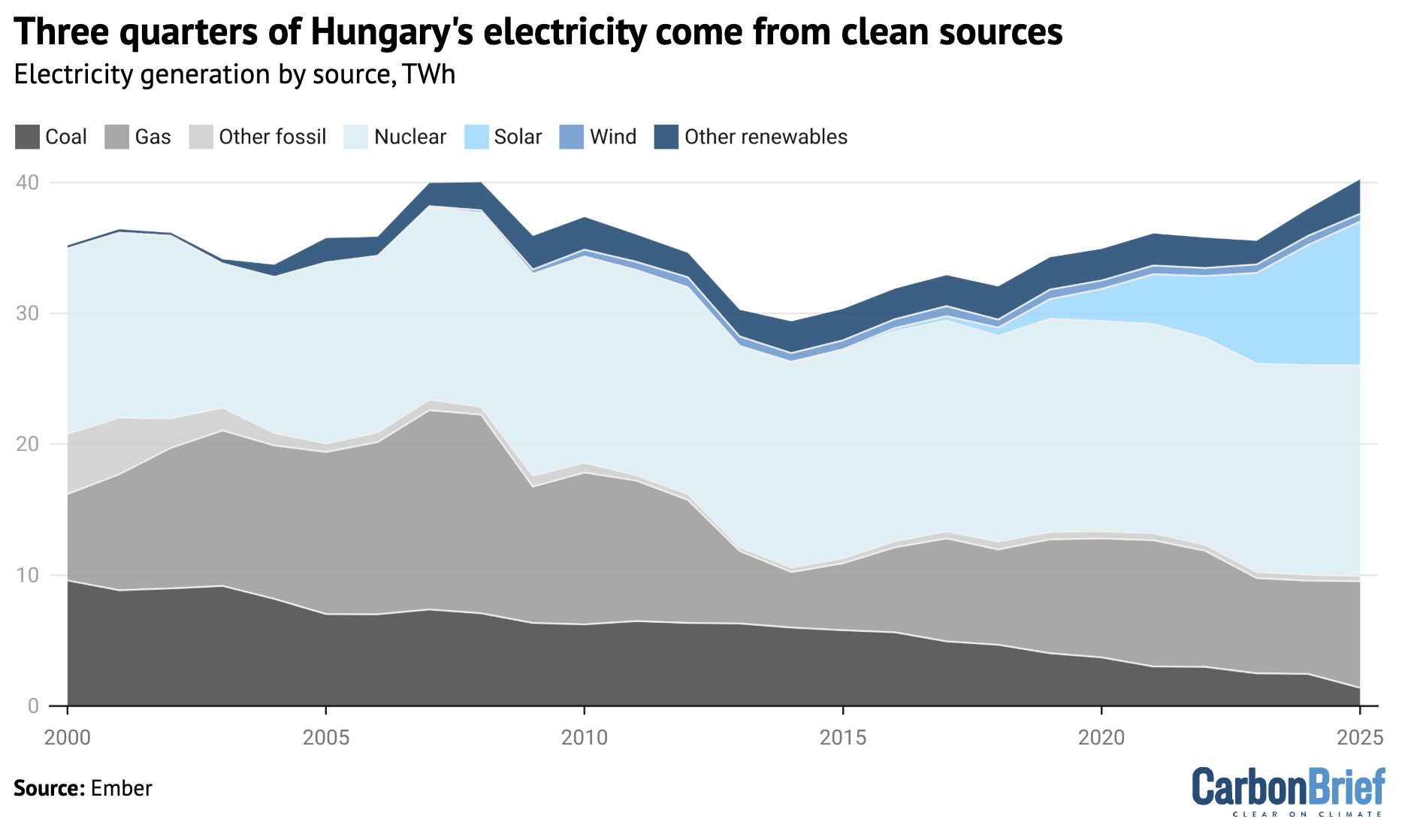
Climate change appeared only briefly during the campaign, yet the Tisza party's detailed 243-page manifesto contains numerous climate-related pledges. These include home insulation programs, electrification of the country's railway network, and national strategies for addressing growing drought risks. The document proposes funding these initiatives with billions of euros in EU funds that had been frozen under Orban due to rule-of-law disputes with Brussels. One of the most striking commitments is to double the share of renewable energy in Hungary's domestic energy supply by 2040. Today, Hungary already generates about three-quarters of its electricity from low-carbon sources, with most coming from the Paks nuclear power plant and nearly a third from solar installations that have grown rapidly thanks to supportive schemes.
One of the most important symbolic and practical shifts expected under Magyar involves wind power. Hungary has effectively no operational wind generation because the Orban government blocked new turbine construction for years through restrictive regulations. The Tisza manifesto explicitly commits to abolishing those restrictions and pairs the new openness on wind with support for geothermal energy. Energy prices, a perennial political issue in Hungary and across Europe, remain sensitive, and Magyar has pledged to maintain and expand the popular utility cost reduction scheme that Orban championed while adding new value-added tax cuts on firewood. Balancing these consumer protections with the need to invest in clean infrastructure will likely be one of the new government's early tests.
Hungary's role as a battery manufacturing hub adds another layer of complexity. Driven by Chinese and South Korean investment, the country has emerged as a major producer of battery cells and components for electric vehicles, even though EV uptake among Hungarian consumers has lagged. The boom has sparked environmental and social concerns, including water use, chemical contamination risks, and local disputes over siting. Analysts expect Magyar to continue supporting the industry because of its economic contribution, but also to apply more stringent environmental oversight and community consultation, particularly if EU funds are used to expand it further. This combination of continuity on industrial policy and change on regulatory rigor could become a signature approach of the new government.
Longer-term implications for European climate diplomacy are substantial. Without Hungary's regular obstruction, EU leaders may find it easier to advance more ambitious mid-century strategies, speed up the Russian energy phaseout, and coordinate major investments in grid modernization and renewable deployment. Analysts caution, however, that Hungary is unlikely to transform into a climate leader overnight. The Tisza party's approach is pragmatic rather than progressive, and its focus is on accessing EU funds and maintaining stable energy supplies rather than pursuing the most aggressive decarbonization pathway. Even so, the shift from a disruptive veto player to a cooperative partner represents a meaningful boost for European climate ambition at a moment when the bloc faces intense competition from the United States and China over clean technology manufacturing and deployment. The coming months will reveal just how deep the change runs as Magyar assembles his cabinet and begins formulating policy.
Civil society organizations and environmental groups across Hungary are already mobilizing to help shape the new government's priorities. Advocacy groups that had operated under restrictive conditions during the Orban years are regaining access to policy discussions and public funding, and they are pressing for faster action on air quality, building energy efficiency, and the protection of forests and wetlands. Universities and research institutes are also poised to play a larger role, with scientists who had been marginalized under the previous government being invited back into advisory roles. Hungarian youth climate movements, long active but often sidelined, see the election as an opening for meaningful dialogue with decision makers. How Magyar's administration responds to these voices will help determine whether Hungary transitions from a reluctant participant in European climate policy into an engaged and constructive partner.