Record-Low Arctic Sea Ice Signals Alarming Climate Trends for the Future
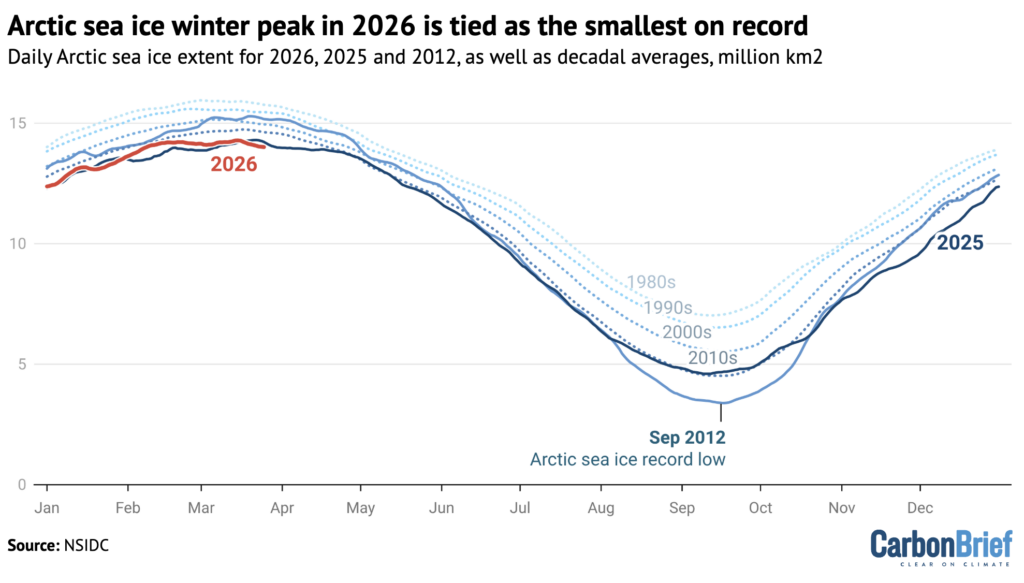
The Arctic region is facing unprecedented challenges, as new data reveals that this year, Arctic sea ice has reached its peak extent at a staggering low point. According to provisional figures from the U.S. National Snow and Ice Data Center (NSIDC), the maximum sea ice extent for this winter settled at 14.29 million square kilometers on March 15, marking a record tie with last year, which is the smallest in nearly half a century of satellite observations. This statistic serves as a crucial indicator in understanding the seasonal cycle of Arctic sea ice, which typically grows during the cold winter months and recedes during the warmer spring and summer periods. The alarming aspect of this data is underscored by climate scientists like Dr. Zack Labe, who emphasizes that this winter is particularly concerning, as the ice thickness is also near record lows, indicating a fragile state as the region transitions to the warmer months ahead.
The past six months have been characterized by a troubling trend of record or near-record lows in Arctic sea ice extent, coinciding with unusual warmth across much of the region. Dr. Lettie Roach, a polar climate scientist at the Alfred Wegener Institute, explains that these factors are interlinked. Warmer air and ocean temperatures contribute to the melting of ice, and in turn, reduced ice cover allows the ocean to absorb more heat, further exacerbating the warming cycle. This creates a feedback loop that poses significant risks to the Arctic ecosystem and, by extension, the global climate. A comparison of recent sea ice extent with historical data shows significant deviations from the decadal averages, illustrating just how drastically the Arctic is changing from the climate norms established over the last several decades.
Recent weather patterns have demonstrated strong temperature contrasts throughout the Northern Hemisphere, with some regions experiencing unusually warm conditions while others have faced cold spells. The western United States, southern Europe, and parts of eastern Eurasia have all shown elevated temperatures, while northern regions of Canada and the northeastern United States have been gripped by colder air. This phenomenon can be attributed to a more “wavy” jet stream, which alters the usual flow of air and allows cold Arctic air to push southward, while simultaneously ushering warmer air into the Arctic. Such shifts have contributed to particularly concerning sea ice conditions in critical areas, including the Sea of Okhotsk and Baffin Bay. The only region showing a relative increase in sea ice is the eastern Bering Sea around Alaska, but this is not enough to counterbalance the overall decline observed across the Arctic.
The peak extent of Arctic sea ice this winter is a stark reminder of the long-term downward trend that has been documented since the late 1970s, when satellite observations began. The NSIDC reports that this year's maximum extent is 1.36 million square kilometers below the 1981-2010 average, a loss equivalent to roughly twice the area of Texas. This decline is not merely a matter of surface area; the ice itself is becoming thinner and more fragile, raising concerns about its ability to withstand the inevitable melting that occurs during the summer months. Dr. Labe notes that the ice near the North Pole has had record-low thickness for several months, and February saw the second-lowest volume of Arctic sea ice recorded. Such statistics paint a grim picture of an ecosystem under siege from climate change, highlighting the urgent need for concerted global action.
While natural fluctuations in atmospheric and oceanic conditions contribute to year-to-year variability in sea ice extent, researchers agree that the long-term trend is primarily driven by human-caused climate change. This reality has profound implications, as Dr. Roach points out that climate change is reshaping the polar environment in ways that are already yielding far-reaching consequences. The steady decline in the maximum winter extent of sea ice is particularly striking compared to the summer minimum, which has remained more susceptible to natural variability. It is too early to definitively ascertain how this low winter peak will influence the upcoming summer melt season, as regional weather patterns can shift rapidly. However, experts like Dr. Labe view this winter as another clear signal of the rapid changes occurring in the Arctic.
Meanwhile, the situation in Antarctica paints a different picture, as sea ice around the southern continent has been reducing during the summer months of the Southern Hemisphere. The region reached its annual minimum extent of 2.58 million square kilometers, but unlike the Arctic, Antarctic sea ice behavior tends to exhibit greater year-to-year variability. These contrasting trends between the two polar regions reflect the complex dynamics of our planet's climate system and underscore the importance of continued monitoring and research. Understanding these changes is essential not only for Arctic and Antarctic ecosystems but also for global weather patterns, sea-level rise, and the health of our planet as a whole. As we move forward, the implications of diminishing sea ice cannot be overstated, emphasizing the urgent need for effective climate action to mitigate these alarming trends.