Renewables Overtake Coal Worldwide as Clean Power Reverses Fossil Fuel Growth
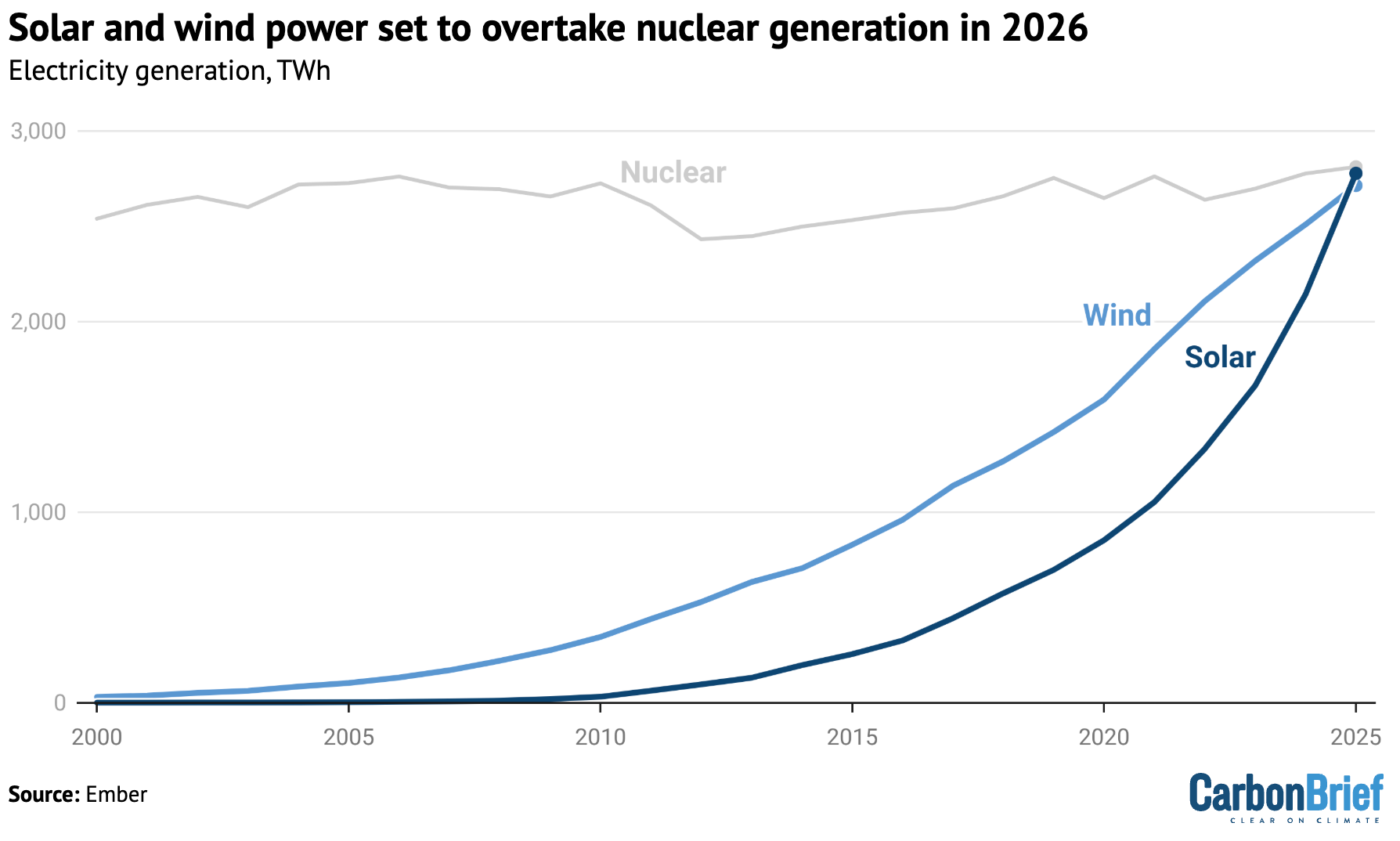
The global energy landscape has crossed a historic threshold in 2025, with renewable electricity sources overtaking coal to become the largest contributor to the world's power supply. According to the climate thinktank Ember, whose annual review tracks the shifting composition of the global grid, this marks the first time since 1919 that coal's share of electricity generation has dipped below that of renewables. The change arrived not as a gradual recalibration but as a structural rupture, driven overwhelmingly by the explosive growth of solar and wind technologies. Fossil-fuel generation fell by 0.2 percent in 2025, and while small annual declines have occurred before during economic shocks, this drop is categorically different because it stems from the accelerating displacement of coal, oil, and gas by cheaper and cleaner alternatives rather than from a recession or pandemic.
Solar energy delivered the headline numbers of the year, expanding by a record 636 terawatt hours, an increase equivalent to roughly twice the annual electricity demand of the United Kingdom. That single year of growth exceeded the electricity that could be generated from every shipment of liquefied natural gas passing through the Strait of Hormuz, amounting to approximately 81 million tonnes of LNG or around 550 terawatt hours of gas-fired power. Wind delivered the second-largest absolute gain, adding 205 terawatt hours and matching the rate of expansion seen in 2024. Taken together, these two technologies met 99 percent of the growth in global electricity demand last year, a figure that captures just how thoroughly clean power has begun to dominate the margin of new supply. Nuclear generation also climbed modestly by 35 terawatt hours, reaching an all-time high of 2,812 terawatt hours, thanks largely to new reactors coming online in China and restarts in France and Japan.
Beneath these generation figures lies an even more telling capacity story. Solar capacity expanded by a record 647 gigawatts during 2025, a pace that suggests the technology will continue to dominate the growth of electricity supply for years to come. The share of wind and solar in the global mix has climbed by more than ten percentage points over the past decade, rising from 23 percent to nearly 34 percent, while coal's share has slid from 38.7 percent to 33 percent over the same window. Remarkably, 81 percent of all wind and solar generation added since the year 2000 has materialized in just the past ten years. By contrast, only 27 percent of fossil fuel growth since 2000 has come during the last decade, a sharp sign that the balance of new investment has tipped decisively toward zero-carbon sources.
Electric mobility reinforced these trends from the demand side. The global electric vehicle fleet continued its rapid expansion through 2025, displacing an estimated 1.8 million barrels of oil demand per day. New vehicles sold during the year alone accounted for 0.5 million barrels per day of displaced oil consumption, illustrating how the transition is beginning to bite into transport fuel demand rather than only power sector emissions. These displacements compound over time, and they occur alongside efficiency gains in industry, buildings, and appliances that are slowly decoupling economic activity from fossil fuel combustion. The net result is that emissions trajectories are beginning to diverge from historical patterns, with Ember estimating that if wind and solar had not scaled over the past quarter century, global fossil fuel generation would be roughly 30 percent higher and power sector emissions about 28 percent higher, adding more than four billion tonnes of carbon dioxide equivalent to the atmosphere every year.
Observers of the transition point out that this turning point has been a long time coming, and that policy momentum, technology learning curves, and capital allocation have all converged to make 2025 the pivotal year. Solar module prices have fallen by roughly 90 percent over the past fifteen years, storage systems have improved in energy density and declined in cost, and interconnection pipelines in major markets now contain more clean capacity than has ever been built at once. Utility planners, once reluctant to commit to variable generation, increasingly treat wind, solar, and batteries as the default choice when retiring coal plants or meeting new demand from data centers and electrification. Financing has also moved, with institutional investors gravitating toward clean infrastructure as fossil fuel assets face stranded risk and regulatory pressure.
Although the 2025 milestone is genuine cause for optimism among climate scientists, the challenge of fully decarbonizing the grid remains substantial. Coal still supplies almost a third of global electricity, and demand growth in parts of Asia and Africa means that clean technologies must be deployed at ever greater scale simply to keep pace. Power sector emissions also represent only part of the climate equation, with transport, heavy industry, agriculture, and aviation requiring their own transitions. Still, the passage of coal from dominance to decline inside the electricity sector is the clearest signal yet that the structural path to a cleaner grid is not only possible but already underway, and Ember's data suggest that by 2026, both solar and wind will each individually overtake nuclear generation for the first time in history.