Seismic Scans Reveal Ancient Tectonic Plates Buried Deep Within Earth Are Still Deforming the Planet's Heart
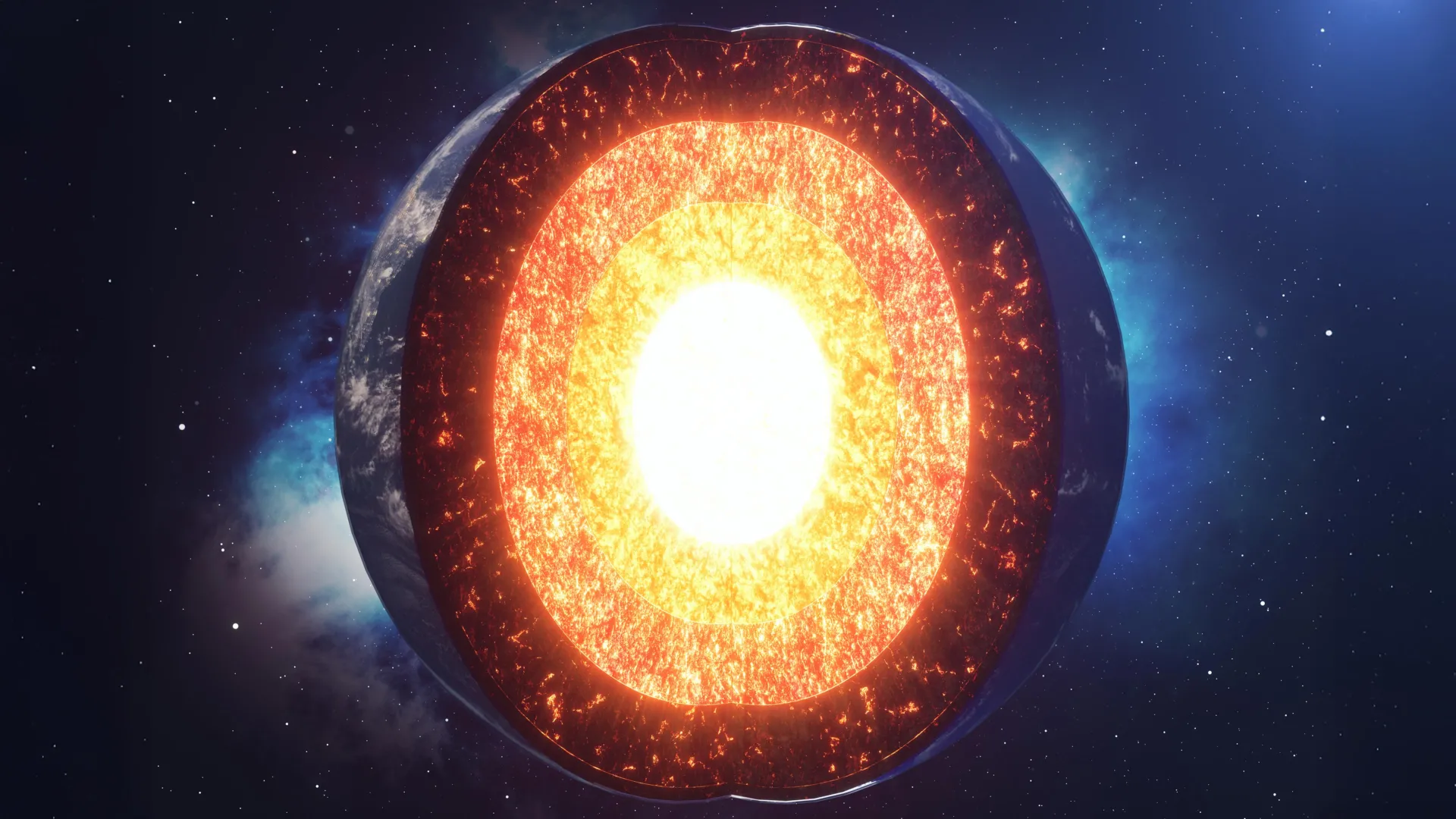
Thousands of kilometers beneath our feet, Earth's mantle is very much alive. A new global analysis of seismic data has mapped in unprecedented detail how the deep mantle is being deformed, revealing that the most intense zones of motion coincide with the locations of long lost tectonic plates that sank into the interior hundreds of millions of years ago. The findings confirm long standing theoretical predictions that ancient subducted slabs should influence the circulation of the mantle for geological eons after they disappear from the surface, and they provide the first planetary scale picture of that influence. The result is a vivid new portrait of the slow churning engine that powers continental drift, volcanism, and the life sustaining cycles of our dynamic planet.
The mantle is the thick layer of hot silicate rock that lies between Earth's molten outer core and the thin rocky crust at the surface. Although it behaves as a solid on short timescales, over millions of years it flows like an extraordinarily viscous fluid, carrying heat outward from the core and shaping the geography of the surface. When tectonic plates converge, one plate can slide beneath another in a process called subduction, descending into the mantle and disappearing from view. Seismologists have long hypothesized that these sunken slabs retain their identity deep in the mantle, acting as cold, dense structures that influence the flow of surrounding material. Until recently, however, observational evidence has been patchy, limited by the difficulty of imaging the deepest parts of the planet.
The new study took advantage of a massive archive of seismic waves generated by earthquakes around the world and recorded by thousands of stations spanning nearly every continent. By analyzing the way these waves travel through the planet, researchers can infer the composition, temperature, and, most importantly, the deformation of the material they pass through. Certain types of waves, called shear waves, are especially sensitive to the orientation of mineral crystals in the mantle, and their behavior depends on how those crystals have been aligned by slow flow over long timescales. Stacking and processing billions of seismic measurements, the team produced a global map of deformation in the deepest mantle and compared it with reconstructions of where ancient tectonic plates descended.
The correspondence is striking. The regions of the mantle where the deformation signal is strongest align closely with the inferred graveyards of ancient plates, lending powerful support to the idea that subducted slabs continue to influence circulation for hundreds of millions of years after their descent. The data also illuminate the pattern of flow around so called large low shear velocity provinces, vast structures beneath Africa and the Pacific Ocean that may be hotter or compositionally distinct from the surrounding mantle. By mapping how material moves around these provinces, the study helps resolve long standing debates about whether they are passive blobs of ancient material or dynamic features actively shaping the evolution of the planet.
Beyond confirming theoretical expectations, the findings have wide ranging implications. Mantle flow controls the drift of continents, the spacing of volcanic hotspots, and the generation of the magnetic field in the outer core, which in turn shields the surface from harmful solar and cosmic radiation. Better maps of deep mantle deformation help scientists understand how heat is transported from the core to the surface, how quickly the planet is cooling, and how the supply of molten rock to volcanoes varies over geological time. The maps also provide insights into the history of mountain building, ocean basin formation, and mass extinction events that may be tied to large scale changes in mantle circulation.
Future work will combine improved seismic networks, including new sensors on the ocean floor, with advances in high pressure mineral physics that reveal how mantle rocks deform under the extreme conditions of the deep interior. Coupled models that simulate mantle flow together with the dynamics of the tectonic plates at the surface will help translate the new observations into a richer picture of how the planet's inside and outside evolve together. For those of us going about our daily lives at the surface, it is easy to forget that the apparently solid ground is the thin skin of a vast, slowly circulating engine. The deep mantle, shaped by plates that vanished long before the first mammals walked the Earth, continues to mold the world we inhabit in ways we are only now beginning to see clearly.
The broader takeaway is that Earth is not a static planet with a restless surface, it is a dynamic body through and through. Every layer, from the thin atmosphere to the molten core, participates in a coupled system where changes at one depth ripple through to others over various timescales. Studying the deep mantle may seem remote from the concerns of daily life, but it bears directly on questions about the habitability of Earth over billions of years, the evolution of the magnetic field that shields biology from harmful radiation, and the tempo of plate tectonic cycles that regulate atmospheric composition through volcanic outgassing and silicate weathering. Each advance in imaging the interior brings a deeper understanding of the planet that makes everything else on its surface possible.