The Expanding South Atlantic Anomaly: A Closer Look at Earth's Magnetic Vulnerability
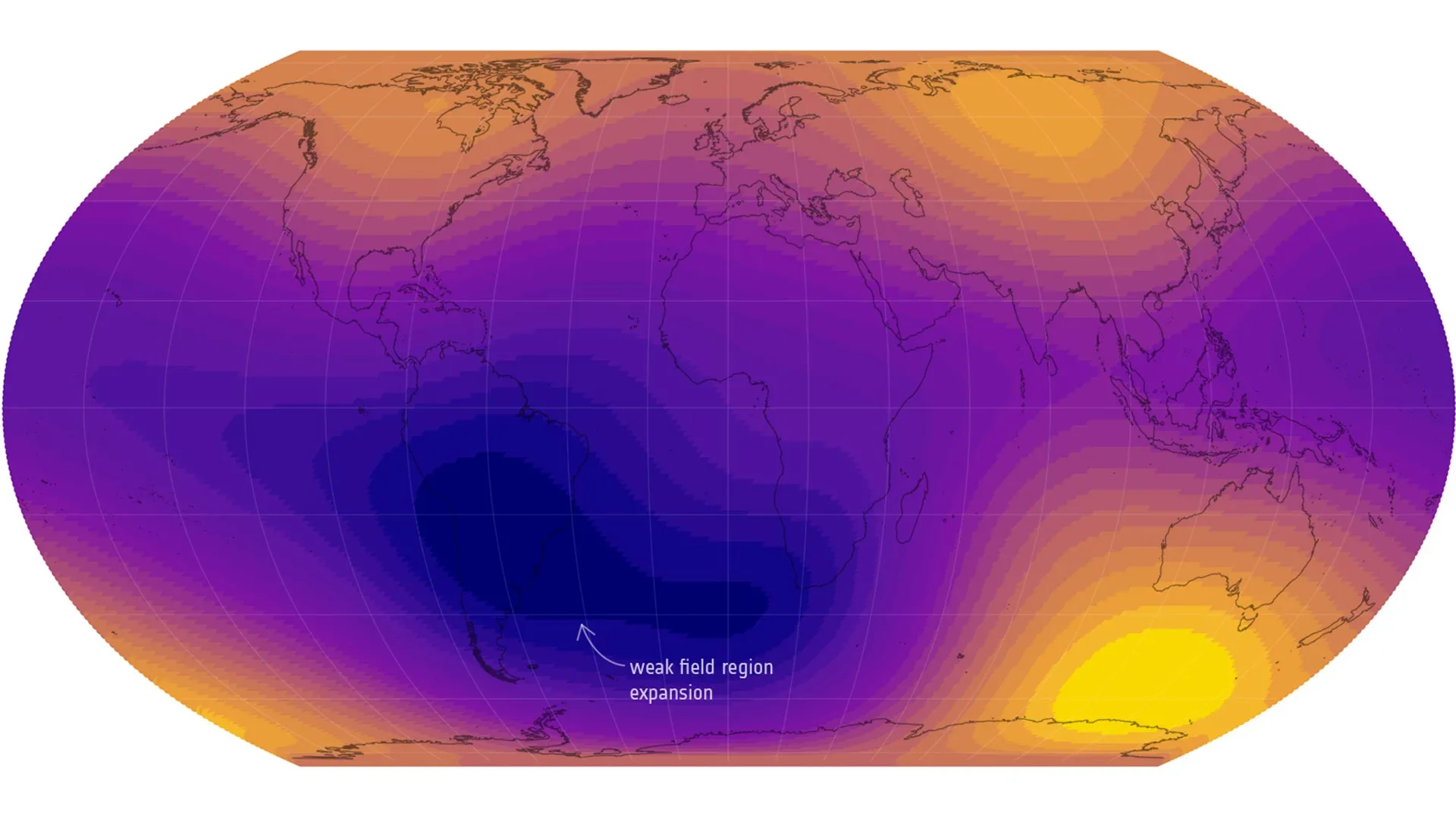
Recent observations from the European Space Agency's Swarm satellites have revealed a concerning trend in Earth's magnetic field, specifically the South Atlantic Anomaly (SAA). This vast region of weakened magnetic strength has seen significant growth, now spanning nearly half the size of continental Europe since 2014. The implications of this expansion are profound, not only for our understanding of Earth's magnetic dynamics but also for the potential effects on technology and the environment. As scientists delve deeper into this phenomenon, it becomes crucial to understand what the SAA is, why it is changing, and what this means for life on Earth.
The South Atlantic Anomaly is characterized by a notable decrease in the intensity of Earth's magnetic field, which can be visualized as a bulge extending from South America to southwestern Africa. This anomaly poses unique challenges, especially for satellites and spacecraft that pass through the area, as they encounter increased levels of radiation. This radiation can lead to malfunctions in electronic systems and pose risks to astronauts in orbit. The rapid growth of the SAA raises questions about the stability of the magnetic field and its protective capabilities against solar and cosmic radiation. As technology continues to advance, understanding the nuances of the SAA will be critical for safeguarding our satellites and the data they collect.
The underlying causes of the SAA's expansion are tied to dynamic processes occurring within Earth's interior, particularly in the molten outer core. The movement of molten iron and other materials generates the magnetic field that envelops our planet. Variations in this flow can lead to fluctuations in magnetic strength, which may explain the rapid weakening observed in the SAA region. Recent studies suggest that this weakening is not merely a local phenomenon but may indicate broader changes in the geodynamo processes that sustain Earth's magnetic field. Monitoring these changes is essential for predicting future shifts and understanding the long-term implications for life on Earth.
Historically, Earth's magnetic field has undergone significant shifts, including complete reversals where the magnetic north and south poles swap positions. These geomagnetic reversals occur over thousands of years, and while scientists have yet to pinpoint a definitive timeline for the next reversal, the current changes in the SAA could provide important clues. The ongoing monitoring of this anomaly allows scientists to gather data that could enhance our understanding of geomagnetic behavior and its potential links to climate change, tectonic activity, and even biological processes.
The implications of a weakening magnetic field extend beyond technical challenges for satellites. Research has shown that shifts in the magnetic field can influence weather patterns, animal navigation, and even the behavior of certain species. Many migratory birds, for instance, rely on Earth's magnetic field for orientation during their long journeys. A disrupted magnetic field could have cascading effects on biodiversity and ecosystems. Moreover, the potential for increased exposure to solar radiation can lead to higher rates of skin cancer and other health issues for populations living in affected areas.
As scientists continue to study the South Atlantic Anomaly, collaboration between international space agencies and research institutions becomes increasingly important. The data obtained from ESA's Swarm satellites not only enhances our understanding of the SAA but also contributes to a global effort to monitor Earth's magnetic field. This knowledge will be vital in preparing for future changes that could impact technology, health, and the environment. With the stakes so high, the ongoing exploration of the SAA serves as a reminder of the intricate relationship between Earth's geological processes and the life forms that inhabit it. Continued investment in research and monitoring will be essential to navigate the challenges posed by a changing magnetic field.