UK Government Moves to Loosen the Grip of Gas Prices on Electricity Bills
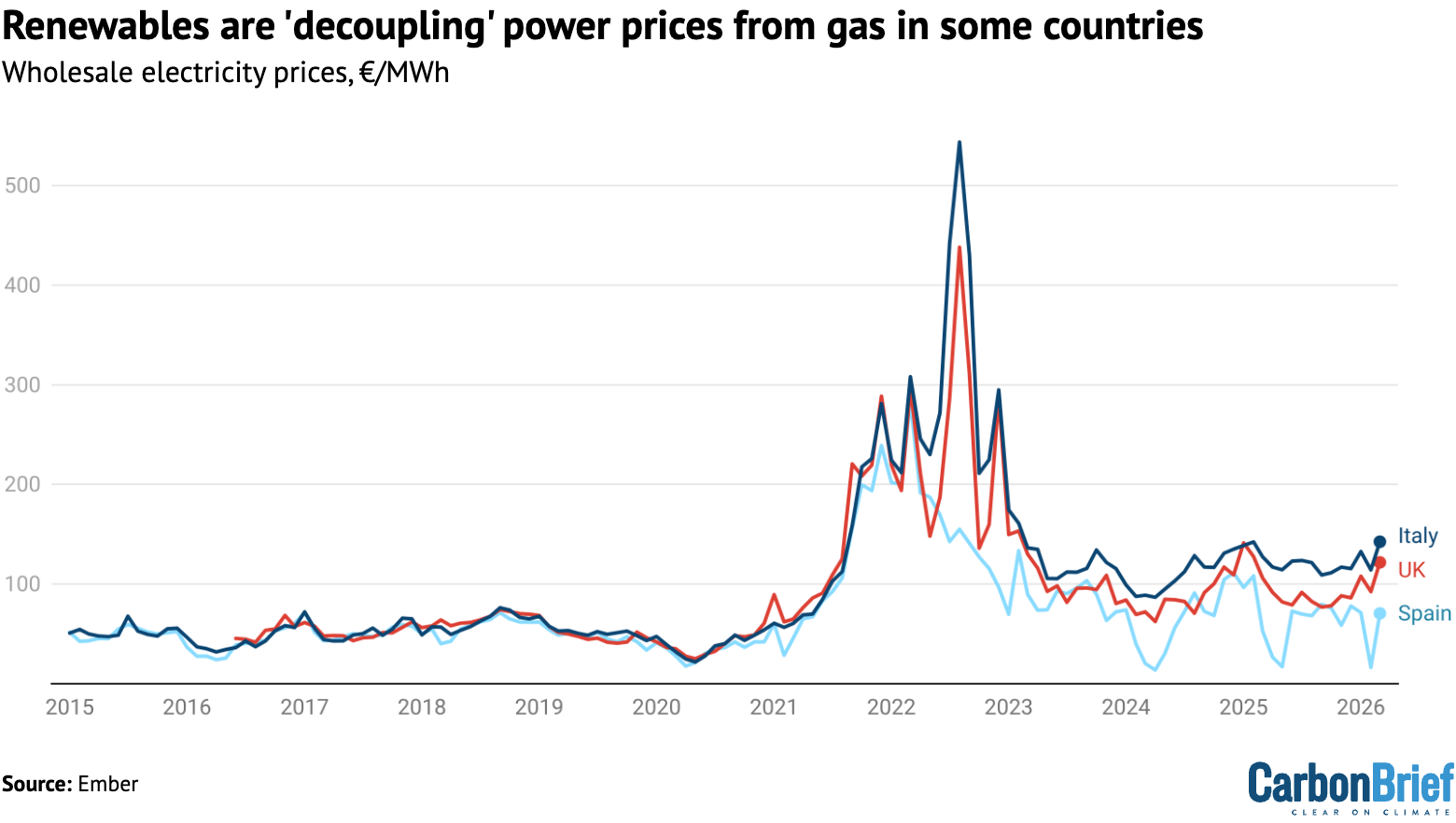
The United Kingdom government has announced a package of measures aimed at weakening the link between gas prices and electricity bills, presenting the plan as part of a broader push toward clean power amid the energy crisis sparked by the war in Iran. While headlines characterized the measures as a decisive break with the past, analysts say the actual changes are more incremental, tightening existing policy levers rather than overhauling the wholesale electricity market.
At the heart of the current system is marginal pricing. In Britain and most other European markets, the cost of electricity in any given half-hour is typically set by the most expensive generator needed to meet demand, which is usually a gas-fired power station. When gas prices rise, electricity prices rise with them, even if the bulk of the power flowing on the grid comes from cheaper renewables or nuclear plants whose costs have not moved. The dependence on gas has been blamed for successive bill shocks during the Ukraine and Iran conflicts.
The government's new approach has two main components. From the first of July 2026, the electricity generator levy, a windfall tax on older renewable and nuclear plants, will be increased. A portion of the new revenue will be recycled to households and businesses in the form of bill relief. In parallel, the government will encourage older renewable projects currently operating under the renewables obligation scheme to sign fixed-price contracts, shielding consumers from future gas-driven price spikes.
The renewables obligation projects are a large class. They account for roughly a third of the country's electricity generation and include many wind farms and biomass plants built during the early years of the clean energy transition. These plants currently earn the wholesale market price, which tracks gas, plus a fixed subsidy in the form of renewable obligation certificates. Moving them onto contracts for difference, which pay a set price per unit regardless of wholesale fluctuations, would reduce consumer exposure to gas markets.
Analysts describe the changes as a step in the right direction but caution that the effect on bills will be modest in the near term. A significant share of the savings will depend on how many renewables obligation operators accept the new contracts, and the financial case will vary from project to project. Over time, continued growth of new renewables and nuclear capacity built under contracts for difference will do more to break the link between gas and electricity than these near-term adjustments on their own.
Industry reaction has been mixed. Consumer advocates welcomed any measure that passes more of the savings from low-cost generation through to bills. Renewable developers expressed caution, warning that poorly designed tax and contract changes can depress investment in the next generation of projects. Gas-fired generators noted that they still provide an essential flexibility service on low-wind days and that any reform must preserve adequate incentives to keep gas plants available, even if they run less often.
The share of hours in which gas sets the power price has already fallen from more than ninety percent in 2021 to around sixty percent today, according to the Department of Energy Security and Net Zero. National Energy System Operator modeling suggests that the government's clean power target for 2030 could push that share below twenty percent, largely through continued buildout of fixed-price renewables. Breaking the link is therefore less a one-time policy change than a gradual process driven by investment decisions.
The political stakes are high. Energy bills remain one of the most visible ways in which voters experience policy choices, and successive governments have struggled to manage the balance between affordability, security, and decarbonization. The new measures are designed to show movement on affordability while continuing to send the long-term signals that new low-carbon investment requires.
For now, households and businesses should expect bills to remain closely tied to international gas markets, at least through the end of the decade. The government's announcement is best read as a marker along a longer journey, one in which fixed-price clean electricity progressively displaces gas at the margin, and the link between gas prices and power bills weakens year by year rather than ending overnight.
Financial markets have begun pricing the implications of the announcement with a mix of caution and optimism. Utility stocks listed on the London exchange dipped modestly on the news, reflecting uncertainty about windfall tax dynamics and the cost of transitioning older renewable projects to new contracts. Investors in forthcoming contract for difference auctions, by contrast, welcomed the signal that the government intends to expand the share of electricity under fixed-price arrangements. Bond markets also reacted, with short-dated gilts moving slightly as traders reassessed the inflation implications of bill relief measures. Households themselves will see the most tangible effects over the coming year. The government has indicated that bill relief payments will be delivered through energy suppliers rather than through direct cash transfers, which reduces administrative friction but may also make the intervention less visible in political terms. Consumer advocacy groups have urged ministers to ensure that the scheme reaches prepayment customers, many of whom were poorly served by earlier crisis interventions. Regulators at the energy watchdog have committed to monitoring delivery closely. The long-term path remains uncertain. A strong recovery in renewables deployment would accelerate the transition away from gas-driven pricing, while any new shock to international gas markets could force further emergency measures. Political attention is also turning toward questions of who bears the cost of the transition, including low income households that disproportionately struggle with energy bills, and industrial users whose competitiveness depends on stable electricity prices. For now, the package announced by ministers represents a tentative rebalancing rather than a wholesale reform, and the debate over how quickly Britain can truly break the link between gas and electricity will continue to unfold over the years ahead.